
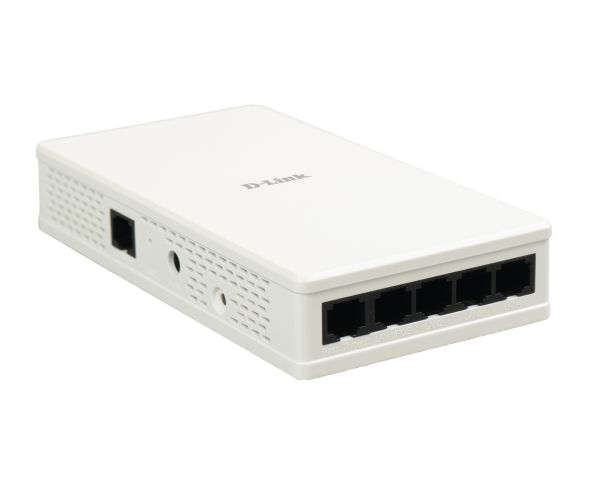
DAP-E3620WNew
Wi-Fi 7 BE3600 Dual-Band Wall Plate PoE Access Point
Description
The DAP-E3620W Wi-Fi 7 BE3600W Dual-Band PoE Access Point is designed for enterprise-class wireless networks with high mobile client density and increased bandwidth requirements in government, budgetary, and commercial organizations, including medical and educational institutions, retail, hotel, and exhibition centers, and public spaces, providing unparalleled bandwidth and flexibility for administrators looking to deploy a medium to large scale Wi-Fi network.
This AP has manageable dual-band wireless LAN options and utilizes the cutting-edge speed of Wireless BE and not only can the AP operate in standalone mode, it can also be centrally managed by D-Link Nuclias Connect. The Nuclias Connect solution provides for easier administration of wireless networks, including continuous monitoring of network activities, equipment configuration automation, performance parameters and network security control etc.
Wi-Fi 7 (802.11be)
The DAP-E3620W leverages cutting-edge technologies such as Multi-Link Operation (MLO) and 4K QAM modulation to enable data transmission across multiple frequency bands simultaneously. Whether supporting bandwidth-intensive applications like cloud gaming and real-time collaboration, Wi-Fi 7 provides the speed, efficiency, and reliability required in today’s high-density, devicerich environments. The DAP-E3620W delivers reliable, high-speed wireless performance with maximum wireless signal rates of up to 688 Mbps over the 2.4 GHz band and up to 2882 Mbps over the 5 GHz band***. This, coupled with support for the Wi-Fi Multimedia™ (WMM) Quality of Service (QoS) feature, makes it an ideal access point for audio, video, and voice applications. When enabled, QoS allows the DAP-E3620W to automatically prioritize network traffic according to the level of interactive streaming, such as HD movies or VoIP. The QoS feature can be adjusted through the DAP-E3620W’s web GUI using a drop-down menu option to select customized priority rules.
Wall Plate-Ready Hardware Design
Compact wall plate form factor designed for seamless in-room and in-building installation. Supports standard wall plate mounting for discreet and space-saving deployment.
2.5-Gigabit Ethernet Port
The DAP-E3620W also deliver fast wired connectivity, significantly reducing network latency and ensuring high throughput for bandwidth-intensive applications. With support for 2.5 GbE speeds, it delivers a stable and efficient wired network experience, ideal for everyday office and business use.
Versatile Access Point Functionality
The DAP-E3620W allows network administrators to deploy a highly manageable and extremely robust simultaneous dual-band wireless network. For advanced installations, the DAP-E3620W has integrated 802.3at Power over Ethernet (PoE) support, allowing the device to be installed in areas where power outlets are not readily available
Security
To help maintain a secure wireless network, the DAP-E3620W supports both Personal and Enterprise versions of WPA, WPA2 (802.11i) and WPA3, with support for RADIUS server backend and a built-in internal RADIUS server allowing users to create their accounts within the device itself. This access point also includes MAC address filtering, wireless LAN segmentation, SSID broadcast disable, rogue AP detection, and wireless broadcast scheduling for further protection of your wireless network. Additionally, the DAP-E3620W supports Network Access Protection (NAP), allowing network administrators to define multiple levels of network access based on individual client's needs.
Multiple Operation Modes
The DAP-E3620W supports several operating modes: Access Point, Wireless Distribution System (WDS), WDS with AP. As a standard wireless access point (AP) the DAP-E3620W can connect to a wide range of devices that are 802.11a/b/g/n/ac/ax/be compliant. In wireless distribution system (WDS) mode it can expand current wireless coverage without the need for a wired backbone link.
Network Management
Network administrators have multiple options for managing the DAP-E3620W, including web (HTTP/HTTPS), Secure Shell (SSH, which provides for a secure channel between local and remote computers) and Telnet.
The DAP-E3620W also can be configured and managed by D-Link Nuclias Connect. In addition, the DAP-E3620W has a wireless scheduler feature, which turns off wireless functionality when it isn’t needed, saving power. With simultaneous dual-band functionality, PoE support, extensive manageability, versatile operation modes, and solid security enhancements, the DAP-E3620W provides enterprise environments with a business-class solution for deploying a wireless network.
General features
Features
• 802.11a/b/g/n/ac/ax/be
• 1x100/1000/2.5GBase-T WAN 802.3at PoE port (PoE In)
• 4 x 10/100/1000Base-T LAN ports (LAN1 port with 802.3af PoE Out support)
• 1 x RJ-45 Passthrough port*
• 1xUSB 2.0 port**
• 1xRJ-45 Concole port
LEDs
• SYS
• 2.4 GHz wireless
• 5 GHz wireless
• WAN
• LAN1
• LAN2
• LAN3
• LAN4
Buttons
• Factory reset button
Antennas
• Two internal antennas with 3 dBi for 2.4 GHz
• Two internal antennas with 3.3 dBi for 5 GHz
MIMO
• 2x2, MU-MIMO
Power connector
• Power input connector (12V DC 2A)
Mounting
• Wall Plate
Wireless Module Parameters
Standards
• IEEE 802.11a/b/g/n/ac/ax/be
Wireless Frequency Range***
• 2.4 GHz: 2.4 GHz to 2.4835 GHz
• 5 GHz: 5.15 GHz to 5.35 GHz, 5.47 GHz to 5.85 GHz
Wireless Security
• WPA-Personal/Enterprise
• WPA2-Personal/Enterprise
• WPA3-Personal/Enterprise
• 64/128-bit WEP encryption
• AES and TKIP
• SSID broadcast disable
• MAC address access control
• Network Access Protection (NAP)
• Internal RADIUS server
• Captive Portal Authentication
Wireless speed
• 802.11a: 6, 9, 12, 18, 24, 36, 48 and 54 Mbit/s
• 802.11b: 1, 2, 5.5 and 11 Mbit/s
• 802.11g: 6, 9, 12, 18, 24, 36, 48 and 54 Mbit/s
• 802.11n: 6.5 ~ 300 Mbit/s
• 802.11ac: 6.5~866 Mbit/s
• 802.11ax: 6.5~2402 Mbit/s
• 802.11be: 6.5~2882 Mbit/s
Transmitter Output Power
• IEEE 802.11a:
20 dBm at 6, 9, 12, 18,24,36,48,54 Mbit/s
• IEEE 802.11b:
20 dBm at 1, 2, 5.5, 11 Mbit/s
• IEEE 802.11g:
20 dBm at 6,9, 12,18, 24,36, 48, 54 Mbit/s
• IEEE 802.11n:
2.4 GHz /HT-20
20 dBm at MCS0~7
2.4 GHz /HT-40
20 dBm at MCS0~7
5 GHz /HT-20
20 dBm at MCS0~7
5 GHz /HT-40
20 dBm at MCS0~7
• IEEE 802.11ac:
VHT20
20 dBm at MCS0~7
19 dBm at MCS8
VHT40
20 dBm at MCS0~7
19 dBm at MCS8~9
VHT80
20 dBm at MCS0~7
19 dBm at MCS8~9
• IEEE 802.11ax:
5G/HE20
20 dBm at MCS0~7
19 dBm at MCS8~9
18 dBm at MCS10~11
5G/HE40
20 dBm at MCS0~7
19 dBm at MCS8~9
18 dBm at MCS10~11
5G/HE80
20 dBm at MCS0~7
19 dBm at MCS8~9
18 dBm at MCS10~11
5G/HE160
20 dBm at MCS0~7
19 dBm at MCS8~9
18 dBm at MCS10~11
• IEEE 802.11be:
5G/EHT20
20 dBm at MCS0~7
19 dBm at MCS8~9
18 dBm at MCS10~11
17 dBm at MCS12~13
5G/ EHT40
20 dBm at MCS0~7
19 dBm at MCS8~9
18 dBm at MCS10~11
17 dBm at MCS12~13
5G/ EHT80
20 dBm at MCS0~7
19 dBm at MCS8~9
18 dBm at MCS10~11
17 dBm at MCS12~13
5G/ EHT160
20 dBm at MCS0~7
19 dBm at MCS8~9
18 dBm at MCS10~11
17 dBm at MCS12~13
Receiver Sensitivity
• IEEE 802.11a:
-92 dBm at 6 Mbit/s
-90 dBm at 9 Mbit/s
-87 dBm at 12 Mbit/s
-84 dBm at 18 Mbit/s
-81 dBm at 24 Mbit/s
-79 dBm at 36 Mbit/s
-77 dBm at 48 Mbit/s
-75 dBm at 54 Mbit/s
• IEEE 802.11b:
-93 dBm at 2 Mbit/s
-89 dBm at 11 Mbit/s
• IEEE 802.11g:
-92 dBm at 6 Mbit/s
-90 dBm at 9 Mbit/s
-88 dBm at 12 Mbit/s
-86 dBm at 18 Mbit/s
-84 dBm at 24 Mbit/s
-81 dBm at 36 Mbit/s
-77 dBm at 48 Mbit/s
-75 dBm at 54 Mbit/s
• IEEE 802.11n:
2.4 GHz /HT-20
-88 dBm at MCS0
-85 dBm at MCS1
-82 dBm at MCS2
-79 dBm at MCS3
-77 dBm at MCS4
-75 dBm at MCS5
-73 dBm at MCS6
-72 dBm at MCS7
2.4 GHz /HT-40
-86 dBm at MCS0
-83 dBm at MCS1
-80 dBm at MCS2
-78 dBm at MCS3
-76 dBm at MCS4
-74 dBm at MCS5
-72 dBm at MCS6
-70 dBm at MCS7
5 GHz /HT-20
-88 dBm at MCS0
-85 dBm at MCS1
-82 dBm at MCS2
-80 dBm at MCS3
-78 dBm at MCS4
-76 dBm at MCS5
-74 dBm at MCS6
-72 dBm at MCS7
5 GHz /HT-40
-86 dBm at MCS0
-83 dBm at MCS1
-80 dBm at MCS2
-78 dBm at MCS3
-76 dBm at MCS4
-74 dBm at MCS5
-72 dBm at MCS6
-70 dBm at MCS7
• IEEE 802.11ac:
VHT20
-88 dBm at MCS0
-85 dBm at MCS1
-82 dBm at MCS2
-79 dBm at MCS3
-76 dBm at MCS4
-73 dBm at MCS5
-70 dBm at MCS6
-67 dBm at MCS7
-65 dBm at MCS8
VHT40
-86 dBm at MCS0
-83 dBm at MCS1
-80 dBm at MCS2
-77 dBm at MCS3
-74 dBm at MCS4
-71 dBm at MCS5
-68 dBm at MCS6
-66 dBm at MCS7
-64 dBm at MCS8
-62 dBm at MCS9
VHT80
-84 dBm at MCS0
-81 dBm at MCS1
-78 dBm at MCS2
-75 dBm at MCS3
-72 dBm at MCS4
-70 dBm at MCS5
-67 dBm at MCS6
-64 dBm at MCS7
-62 dBm at MCS8
-60 dBm at MCS9
• IEEE 802.11ax:
5G/HE20
-90 dBm at MCS0
-87 dBm at MCS1
-84 dBm at MCS2
-81 dBm at MCS3
-78 dBm at MCS4
-75 dBm at MCS5
-73 dBm at MCS6
-70 dBm at MCS7
-68 dBm at MCS8
-65 dBm at MCS9
-62 dBm at MCS10
-60 dBm at MCS11
5G/HE40
-88 dBm at MCS0
-85 dBm at MCS1
-82 dBm at MCS2
-79 dBm at MCS3
-76 dBm at MCS4
-73 dBm at MCS5
-70 dBm at MCS6
-67 dBm at MCS7
-64 dBm at MCS8
-62 dBm at MCS9
-60 dBm at MCS10
-58 dBm at MCS11
5G/HE80
-84 dBm at MCS0
-81 dBm at MCS1
-78 dBm at MCS2
-75 dBm at MCS3
-73 dBm at MCS4
-70 dBm at MCS5
-67 dBm at MCS6
-64 dBm at MCS7
-61 dBm at MCS8
-58 dBm at MCS9
-56 dBm at MCS10
-54 dBm at MCS11
5G/HE160
-82 dBm at MCS0
-80 dBm at MCS1
-78 dBm at MCS2
-75 dBm at MCS3
-73 dBm at MCS4
-70 dBm at MCS5
-67 dBm at MCS6
-64 dBm at MCS7
-61 dBm at MCS8
-58 dBm at MCS9
-56 dBm at MCS10
-54 dBm at MCS11
• IEEE 802.11be:
5G/ EHT20
-86 dBm at MCS0
-83 dBm at MCS1
-80 dBm at MCS2
-77 dBm at MCS3
-74 dBm at MCS4
-70 dBm at MCS5
-68 dBm at MCS6
-63 dBm at MCS7
-61 dBm at MCS8
-59 dBm at MCS9
-57 dBm at MCS10
-56 dBm at MCS11
-55 dBm at MCS12
-54 dBm at MCS13
5G/EHT40
-84 dBm at MCS0
-82 dBm at MCS1
-80 dBm at MCS2
-78 dBm at MCS3
-74 dBm at MCS4
-70 dBm at MCS5
-65 dBm at MCS6
-63 dBm at MCS7
-60 dBm at MCS8
-58 dBm at MCS9
-56 dBm at MCS10
-54 dBm at MCS11
-53 dBm at MCS12
-52 dBm at MCS13
5G/EHT80
-82 dBm at MCS0
-80 dBm at MCS1
-78 dBm at MCS2
-75 dBm at MCS3
-70 dBm at MCS4
-65 dBm at MCS5
-63 dBm at MCS6
-62 dBm at MCS7
-60 dBm at MCS8
-58 dBm at MCS9
-56 dBm at MCS10
-54 dBm at MCS11
-52 dBm at MCS12
-50 dBm at MCS13
5G/EHT160
-80 dBm at MCS0
-77 dBm at MCS1
-74 dBm at MCS2
-71 dBm at MCS3
-68 dBm at MCS4
-63 dBm at MCS5
-62 dBm at MCS6
-60 dBm at MCS7
-57 dBm at MCS8
-55 dBm at MCS9
-53 dBm at MCS10
-51 dBm at MCS11
-50 dBm at MCS12
-48 dBm at MCS13
Functionality
Network Management
• Web-based User Interface (HTTP/HTTPS)
• Telnet
• Secure Telnet (SSH)
• Traffic control
• Nuclias Connect
• Command Line Interface (CLI)
• SNMP
Operating Modes
• Access Point
• WDS
• WDS with AP
Supported Features
• Quality of Service (QoS)
• Multi-SSID
• VLAN
• Wireless intrusion
• Internal RADIUS server
• Band Steering
• Airtime Fairness
• Fast Roaming (only when using Nuclias Connect controller)
• 802.11k/r Wi-Fi Roaming Protocols****
• ARP Spoofing Prevention
• Bandwidth Optimization
• DHCP Server
• MAC address access control
• Wireless Multimedia (WMM)
Standards
• IEEE 802.3u
• IEEE 802.3ab
• IEEE 802.3bz
• IEEE 802.3az Energy-Efficient Ethernet (EEE)
• IEEE 802.3at Power over Ethernet
Physical Parameters
Weight
• 260 g
Dimensions (L x W x H)
• 160 x 86 x 29 mm
Operation Conditions
Power Supply
• External Power Adapter (not included): (12V DC 2A)
• IEEE 802.3at PoE
Max Power Consumption
• 14.53 W (without PoE Out port)
• 21.53 W (with PoE Out port)
Temperature
• Operating: 0 to 40 °C
• Storage: -20 to 65 °C
Humidity
• Operating: 10% to 90% (Non-condensing)
• Storage: 5% to 95% (Non-condensing)
Certifications
• FCC
• CE
• RCM
*Ethernet Passthrough Port keeps the in-room wall jack available for wired devices.
**The USB port is reserved and currently has no available functions.
***The available operating frequency ranges vary depending on the regulations of individual countries and jurisdictions. Some frequency ranges may be unavailable in certain regions.
****Available when managed by the Nuclias controll
Certificates
Order info
DAP-E3620W Wi-Fi 7 BE3600 Dual-Band Wall Plate PoE Access Point
Pictures
DAP-E3620W/A


